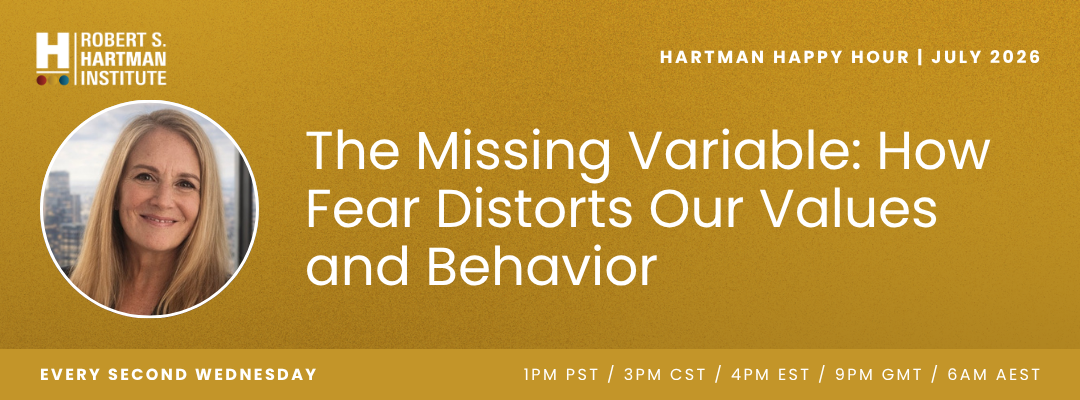
The Missing Variable: How Fear Distorts Our Values and Behavior
What if the behaviors we find most frustrating in others are not driven by bad intentions, but by fear?
That question formed the foundation of this month's Hartman Happy Hour, where Kimberly Giles explored how fear influences our values, decisions, and relationships through the lens of axiology. Drawing on years of experience working with individuals, couples, and organizations, Kimberly demonstrated how understanding the fears beneath human behavior can transform the way we lead, communicate, and relate to one another.
Rather than viewing fear as simply an emotion, the session challenged participants to see it as a powerful force that shapes how we perceive the world and the people around us.
Fear: The Missing Variable
Kimberly began by exploring why fear may be one of the most overlooked influences on human behavior.
When people feel threatened, whether by failure, rejection, uncertainty, or loss, their focus naturally shifts toward self-protection. In these moments, qualities such as empathy, curiosity, patience, and compassion become more difficult to access. Instead, people often react instinctively, making decisions based on perceived safety rather than their highest values.
Understanding this dynamic helps explain why otherwise thoughtful people can behave in ways that seem defensive, controlling, or dismissive when under pressure.
Rather than asking why someone behaved badly, Kimberly encouraged participants to ask a different question: What fear might be driving this response?
Understanding Fear Through Axiology
Using Hartman's framework of intrinsic, extrinsic, and systemic values, Kimberly explained how our value priorities often shift when fear takes hold.
Under normal circumstances, people may naturally value relationships, thoughtful decision-making, and meaningful connection. However, when fear becomes dominant, those higher values can be overshadowed by an urgent need for certainty, control, or protection.
This perspective offers a practical way of understanding conflict. Instead of seeing disagreement as evidence of bad character, axiology encourages us to consider the values and fears influencing another person's actions.
For leaders, coaches, consultants, and anyone working closely with people, this shift creates opportunities for more productive conversations and healthier relationships.
Two Common Fear Patterns
Kimberly introduced two broad fear patterns that often influence behavior throughout life.
The first is a fear of failure, where individuals become preoccupied with not being enough, making mistakes, or losing approval. The second is a fear of loss, where people focus on protecting themselves, those they care about, or the things they value most.
While everyone experiences both forms of fear, many people naturally lean toward one pattern more than the other. These tendencies influence how individuals approach conflict, decision-making, communication, and relationships.
Recognizing these patterns can help explain why people respond so differently to the same situation and why empathy often begins with understanding another person's perspective rather than assuming harmful intent.
The 12 Shapes Framework
Building on these ideas, Kimberly introduced her "12 Shapes" personality framework, an axiology-based model designed to help identify the different ways people seek safety when they feel threatened.
Rather than placing people into rigid personality categories, the framework highlights how different fear responses influence behavior. Actions that may appear controlling, avoidant, critical, or overly accommodating often represent attempts to restore a sense of safety rather than deliberate efforts to create conflict.
By looking beyond observable behavior to the underlying values and fears, the framework offers a practical tool for improving communication, coaching, leadership, and personal relationships.
Choosing Curiosity Over Judgment
One of the most meaningful discussions of the session centered on judgment.
Participants reflected on situations where they found certain behaviors difficult to understand or accept. Rather than focusing on individual stories, the conversation explored how easily fear can influence both our own reactions and the assumptions we make about others.
Kimberly suggested that recognizing another person's search for safety makes compassion more accessible. Curiosity replaces criticism, allowing conversations to become less about assigning blame and more about understanding what is really happening beneath the surface.
This shift from judgment to empathy reflects one of the central aims of axiology: recognizing the intrinsic worth of every person, even when their behavior is difficult or challenging.
Living from Clarity Rather Than Fear
The session concluded by encouraging participants to become more aware of their own fear responses.
By learning to recognize when fear is influencing our thinking, we create space to respond from clarity rather than reaction. This awareness allows us to reconnect with our values, strengthen our relationships, and make decisions that better reflect who we want to be.
Whether applied in leadership, coaching, family life, or everyday conversations, Kimberly's insights demonstrated that understanding fear is not about avoiding difficult emotions. It is about developing the awareness to move beyond them, allowing empathy, wisdom, and sound judgment to guide our actions.
Continue the Conversation
Hartman Happy Hours give members the opportunity to explore the practical application of axiology through engaging presentations and meaningful discussion with a global community of practitioners.
To watch the full recording of this session and attend future Hartman Happy Hours live, become a member of the Robert S. Hartman Institute today. Robert S. Hartman Institute Membership Page