Maintaining Curiosity Under Pressure: Axiology in Real-Time Leadership
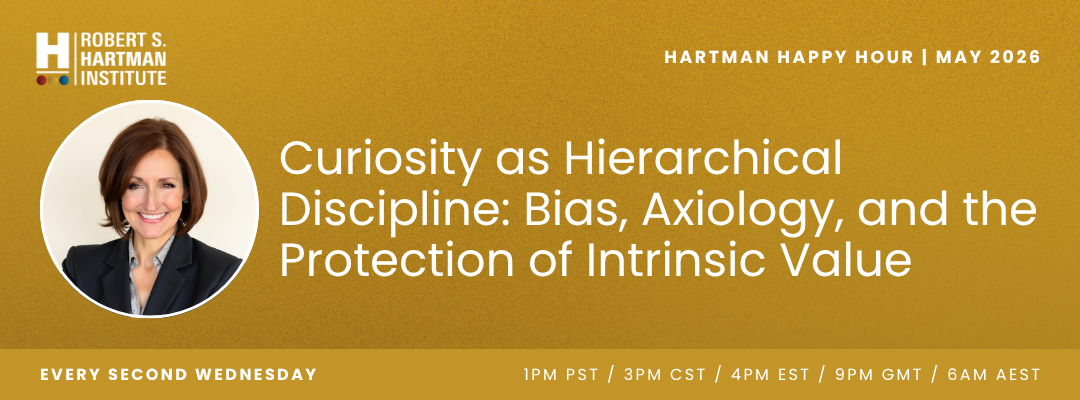
The May 2026 Hartman Happy Hour brought members together for a deeply engaging and practical session led by Christine Kahane, founder of the Institute for Unlearning and Coherence Company. Through an immersive leadership exercise, participants explored one of the most challenging aspects of axiological practice: how to remain curious, coherent, and human-centered while operating under pressure.
Rather than approaching axiology as an abstract theory, the session invited attendees into a lived experience of value-based decision-making in real time.
The Scenario: Leadership in Crisis
Participants were presented with a fictional but highly realistic corporate scenario. A company had missed multiple financial targets, investor confidence was declining, and a whistleblower-style email from a respected employee raised concerns that the organization was no longer living according to its stated values.
Attendees were asked to quickly assume one of several executive roles, including CFO, Head of HR, Communications Director, CEO, or final decision-maker. Under strict time pressure and with incomplete information, each participant had to determine how they would respond.
The exercise immediately revealed something powerful: the same situation can produce dramatically different decisions depending on which values are prioritized.
Some participants focused on protecting the organization’s reputation and minimizing external fallout. Others emphasized transparency, employee trust, and honoring the courage of the employee who raised concerns. Several participants wrestled with the tension between maintaining systemic stability and preserving intrinsic human value.
What emerged was not a “right answer,” but a vivid demonstration of how axiological perspectives shape leadership behavior in real time.
Curiosity as a Discipline
A central theme throughout the Happy Hour was curiosity — not simply as openness or wonder, but as a disciplined refusal to collapse complexity too quickly.
Christine explored how pressure often drives people toward certainty and reductionism. In organizational settings, this can lead to individuals being treated as functions, risks, or obstacles rather than as persons with intrinsic worth.
The discussion highlighted how easy it is for leaders to narrow their focus under stress:
Protect the brand
Contain the problem
Control the narrative
Satisfy the board
Yet axiology challenges leaders to remain spacious enough to hold multiple dimensions of value simultaneously.
Participants reflected on the importance of slowing interpretation long enough to ask deeper questions:
What values are actually being protected?
Who is being reduced to a role or function?
What happens to trust when people no longer feel seen or heard?
How can organizations maintain coherence under systemic strain?
For many attendees, the exercise illuminated how quickly even well-intentioned leaders can default toward extrinsic or systemic valuation when operating under pressure.
Bringing Axiology Into Organizational Life
The conversation expanded into practical applications within leadership, coaching, healthcare, and corporate environments.
Christine shared insights from her work with organizations, including the challenges leaders face when trying to sustain human-centered values within hierarchical systems. She described methods she uses to help teams identify systemic pressure points, communication breakdowns, and “signal suppression” — moments when important concerns are ignored or minimized in favor of maintaining stability.
Participants also explored the role of trust in organizational culture. Several contributors emphasized that people are more willing to engage honestly when they believe leaders genuinely care, listen, and remain accessible during difficult conversations.
An especially meaningful thread throughout the discussion was the distinction between theoretical understanding and embodied practice. Rather than simply teaching axiological concepts intellectually, Christine emphasized experiential exercises that allow individuals to feel the tension between intrinsic, extrinsic, and systemic value priorities as they arise in real-world decision-making.
Axiological Intelligence and the Future of Leadership
Toward the end of the session, the group explored the idea of “Axiological Intelligence,” described as the capacity to discern what truly matters in any moment and respond with wisdom and grace.
The concept resonated strongly with participants, particularly in the context of modern organizational life and the increasing influence of artificial intelligence and rapid decision-making systems. The discussion highlighted the growing importance of cultivating distinctly human capacities such as discernment, empathy, coherence, and value-awareness.
The session concluded with rich reflections on leadership, communication, hierarchy, and the ongoing challenge of sustaining intrinsic value within systems designed around speed and performance.
More than a theoretical discussion, the May Happy Hour offered participants a lived experience of axiology in action — demonstrating how values shape perception, decision-making, and ultimately the cultures we create together.
If you would like to watch the full Happy Hour recording and participate in future live discussions, consider becoming a member of the Robert S. Hartman Institute Membership Page. Members receive access to exclusive recordings, educational resources, community conversations, and upcoming Hartman Happy Hours throughout the year.