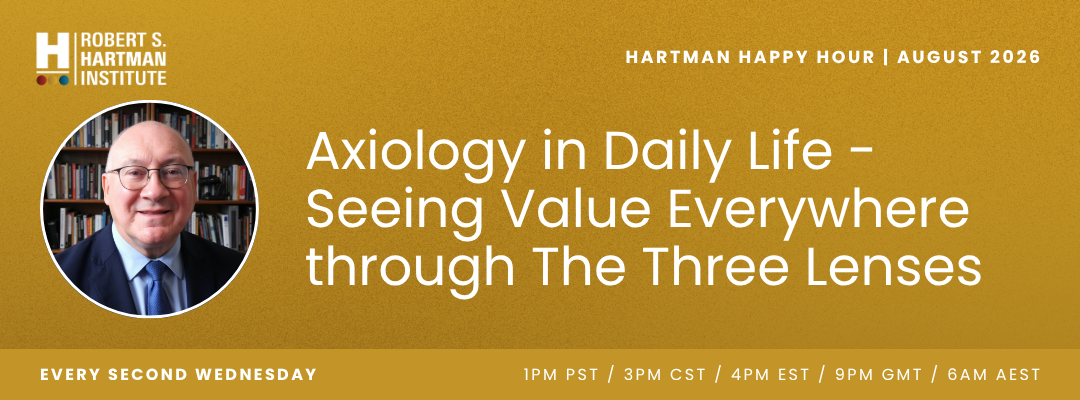
Axiology in Daily Life - Seeing Value Everywhere through The Three Lenses
Axiology is not only something to study. It is something we can use every day to make clearer decisions, understand competing perspectives, and create greater value. In this Hartman Happy Hour, Marc Andonian explored how the three dimensions of value, systemic, extrinsic, and intrinsic, can provide a practical framework for seeing what is often invisible in our everyday choices.
Seeing Through Three Lenses
Marc introduced the idea of “trinocular vision”, a way of looking at situations through all three value dimensions rather than relying on a single perspective.
The systemic lens helps us consider rules, principles, structures, and consistency. The extrinsic lens focuses on measurable qualities, usefulness, outcomes, and practical consequences. The intrinsic lens allows us to recognize the unique value of people and what matters in itself.
All three perspectives have a legitimate place. The challenge comes when one lens dominates or when the proper hierarchy of value is reversed. Marc described these as value inversions, where something of lesser value can unintentionally become more important than something of greater value.
This can happen without bad intentions. We may simply become so accustomed to viewing a situation through our preferred lens that we fail to notice what the other dimensions are telling us.
From Axiology to Everyday Decisions
A central theme of the session was making axiology practical. Rather than treating value theory as an abstract concept, Marc demonstrated how the three lenses can be brought into everyday decision-making.
He introduced a decision protocol designed to help people pause, identify their default way of seeing a situation, examine the different value dimensions, and consider whether their eventual choice reflects the proper hierarchy of value.
This process creates an opportunity to move from an immediate reaction toward a more deliberate understanding of what is actually at stake.
The discussion also explored the Central Question, a tool for examining whether a decision is creating the greatest possible net value. Used consistently, the question can become a practical discipline for individuals, coaches, leaders, and organizations seeking greater coherence in how they make choices.
Why Reflection Can Be Difficult
One of the challenges raised during the discussion was that axiological reflection is not always easy.
When people are strongly attached to a particular position, questioning their assumptions can feel threatening. What appears to be resistance may sometimes reflect an unwillingness or inability to step outside a familiar way of valuing.
The group explored how reflective questioning can create space for people to examine their assumptions without simply being told that they are wrong. Instead of arguing over which position is correct, the process invites deeper questions: What are we actually trying to accomplish? What value are we creating? And are our goals compatible with the way we are pursuing them?
This shift from defending a position to examining its purpose can open the door to more productive conversations.
Applying the Three Lenses to Real-World Issues
Marc demonstrated that the framework can be applied far beyond individual decision-making. The discussion considered examples from public policy, education, governance, and even the debate surrounding daylight saving time.
These examples illustrated how the same issue can look very different depending on which value dimension is emphasized. A decision that appears economically beneficial through an extrinsic lens may raise very different questions when considered in terms of human well-being or intrinsic value.
The point is not to use axiology to support a particular political position. Rather, the Three Lenses provide a way to examine what different decisions value, what purposes they serve, and what consequences follow when one dimension is prioritized over another.
This approach can be particularly useful in complex environments where people may agree on a desired outcome but disagree about how that outcome should be achieved.
From Personal Gain to Value Creation
Another important theme was the distinction between getting value and creating value.
The conversation explored how individuals and organizations can become focused on achieving their own goals without considering the broader effects of those goals. Axiological thinking encourages us to look beyond immediate desires and ask whether our actions contribute to value creation for others as well.
This is especially important in leadership and organizational settings. Clear goals are not enough if those goals are disconnected from a meaningful purpose or create unintended consequences elsewhere in the system.
By bringing the three value dimensions into view, we can begin to ask not only “What do I want?” but also “What truly matters here?” and “What would create the greatest value?”
Making Axiology a Practice
Perhaps the most practical message from the session was that understanding axiology is different from living axiology.
The Three Lenses become most useful when they are incorporated into everyday habits of thinking, questioning, and decision-making. Whether navigating a personal relationship, making a business decision, evaluating a policy, or working through a difficult conversation, taking time to consider systemic, extrinsic, and intrinsic value can reveal possibilities that a single perspective may miss.
The goal is not simply to make better individual decisions. It is to develop a more coherent way of seeing value and applying that understanding to the world around us.
Explore the Full Conversation
This Hartman Happy Hour offered a practical introduction to bringing axiological thinking into everyday life. Members can watch the full recording in the Members Area and join future Hartman Happy Hours live, where these ideas can be explored through conversation, examples, and shared inquiry. Become a Hartman Institute Member
Marc Andonian, PhD is an executive coach, former senior executive, and certified axiology consultant whose work focuses on helping people make clearer, wiser, and more integrated decisions. He is the founder of Meaningful Metrics and author of The Three Lenses – How to See Clearly, Decide Wisely, and Live with Integrity, a practical framework that brings Hartman’s value science into everyday leadership and life. Marc’s teaching blends rigorous axiology with accessible tools that help individuals see the whole picture before they decide.