Perception, Reality, and Human Potential: Exploring the Hidden Forces That Shape Behavior
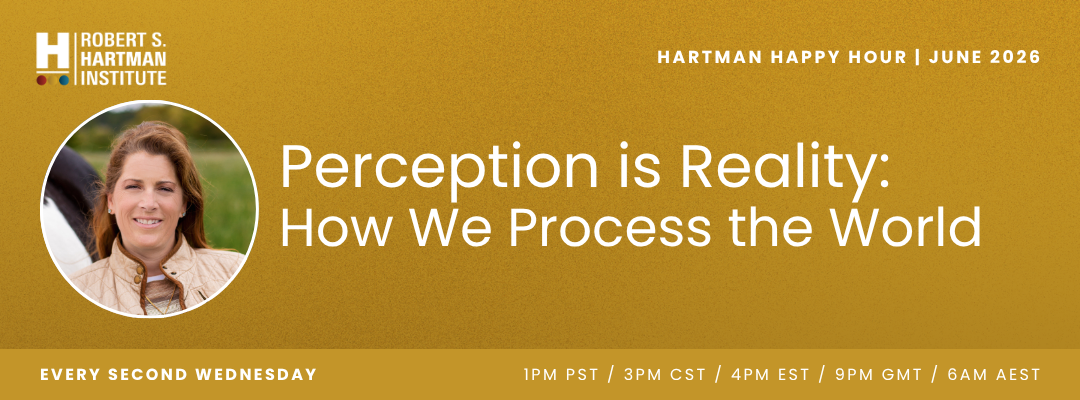
At a recent Hartman Happy Hour, Helena Rouhe led an engaging exploration of perception, reality, and cognitive psychology, examining how the ways we experience the world influence our decisions, relationships, and potential for growth. Drawing on her background in therapy and behavioral science, Helena connected these concepts to practical coaching and human development, offering participants valuable insights into the often unseen factors that shape human behavior.
The session invited attendees to consider a fundamental question: Do we respond to reality itself, or to our perception of reality?
How We Learn to See the World
Helena began by exploring the foundations of human perception, explaining how both genetics and environmental experiences contribute to the way individuals interpret and navigate their surroundings.
From infancy, human beings are constantly gathering information and developing patterns of understanding. Our brains are designed to help us survive, learn, and form connections, but these same systems can also create biases, assumptions, and blind spots that influence how we view ourselves and others.
Through examples from neuroscience and cognitive psychology, Helena illustrated how perception is not simply a passive observation of reality. Instead, it is an active process shaped by biological predispositions, life experiences, and the meanings we assign to events.
This perspective offers an important reminder for coaches, consultants, and leaders: people often respond not to objective circumstances, but to the reality they perceive.
Understanding Defense Mechanisms as Tools
A major theme of the presentation was the role of defense mechanisms in human behavior.
Rather than viewing defense mechanisms as inherently negative, Helena described them as psychological tools that help individuals process information, manage stress, and cope with overwhelming situations. Problems arise not because defense mechanisms exist, but because people often remain unaware of how these patterns influence their thoughts, emotions, and actions.
The discussion explored how different individuals tend to rely on different coping strategies and how these responses can affect relationships, decision-making, and personal development.
For professionals working in coaching, consulting, healthcare, or leadership, understanding these patterns can provide valuable insight into why people become stuck, resistant, or disconnected from their goals.
Bridging the Gap Between Expectations and Reality
One of the most practical aspects of the session focused on helping people recognize the gap between expectations and reality.
Helena shared examples from her therapeutic work, including situations where individuals had become strongly attached to labels, diagnoses, or self-perceptions that were limiting their ability to move forward.
Rather than focusing solely on problems or deficits, she emphasized the importance of helping people identify realistic challenges while also recognizing their strengths and capabilities.
This strengths-based approach aligns closely with axiological thinking. Rather than reducing people to a diagnosis, a performance issue, or a perceived weakness, it encourages a more complete understanding of the individual and their unique potential.
Participants explored how this perspective can help clients build confidence, make better decisions, and create more effective pathways toward personal and professional success.
Intrinsic, Extrinsic, and Systemic Dimensions of Human Behavior
Throughout the presentation, Helena introduced a framework that integrates intrinsic, extrinsic, and systemic dimensions of human experience.
For those newer to Hartman concepts, these three dimensions provide a way of understanding different aspects of value:
Intrinsic value relates to the uniqueness and dignity of the individual person.
Extrinsic value relates to skills, abilities, performance, and measurable outcomes.
Systemic value relates to structures, rules, beliefs, and frameworks that help organize experience.
Helena demonstrated how perception, defense mechanisms, and behavior can be better understood when viewed through these interconnected lenses.
By recognizing how these dimensions interact, coaches and practitioners can gain a more balanced understanding of the people they serve and avoid overly simplistic explanations for complex human challenges.
Focusing on Strengths to Unlock Potential
An especially engaging discussion emerged around a case study involving an individual struggling to maintain stable employment while navigating significant life transitions.
Rather than focusing primarily on perceived shortcomings, Helena advocated for identifying and building upon existing strengths. She explained how helping individuals recognize their capabilities often creates more meaningful and lasting change than concentrating exclusively on deficits.
This approach resonated strongly with participants and highlighted a central theme of the session: people are often far more capable than their current circumstances suggest.
When individuals learn to see themselves differently, their behavior, confidence, and opportunities can begin to change as well.
Perception, Possibility, and Human Growth
As the discussion drew to a close, participants explored the relationship between perception and outcomes. Questions were raised about how beliefs influence performance, how individuals construct their personal realities, and how coaches can help clients distinguish between limitations that are real and those that are merely perceived.
The conversation reinforced the idea that personal growth often begins with awareness. By understanding how perception shapes experience, individuals gain greater freedom to make intentional choices, challenge assumptions, and create new possibilities.
The session offered a rich blend of cognitive psychology, practical coaching insights, and axiological principles, providing attendees with tools they can apply in both professional and personal contexts.
If you would like to watch the full Happy Hour recording and participate in future live discussions, consider becoming a member of the Robert S. Hartman Institute Membership Page. Members receive access to exclusive recordings, educational resources, community conversations, and upcoming Hartman Happy Hours throughout the year.